
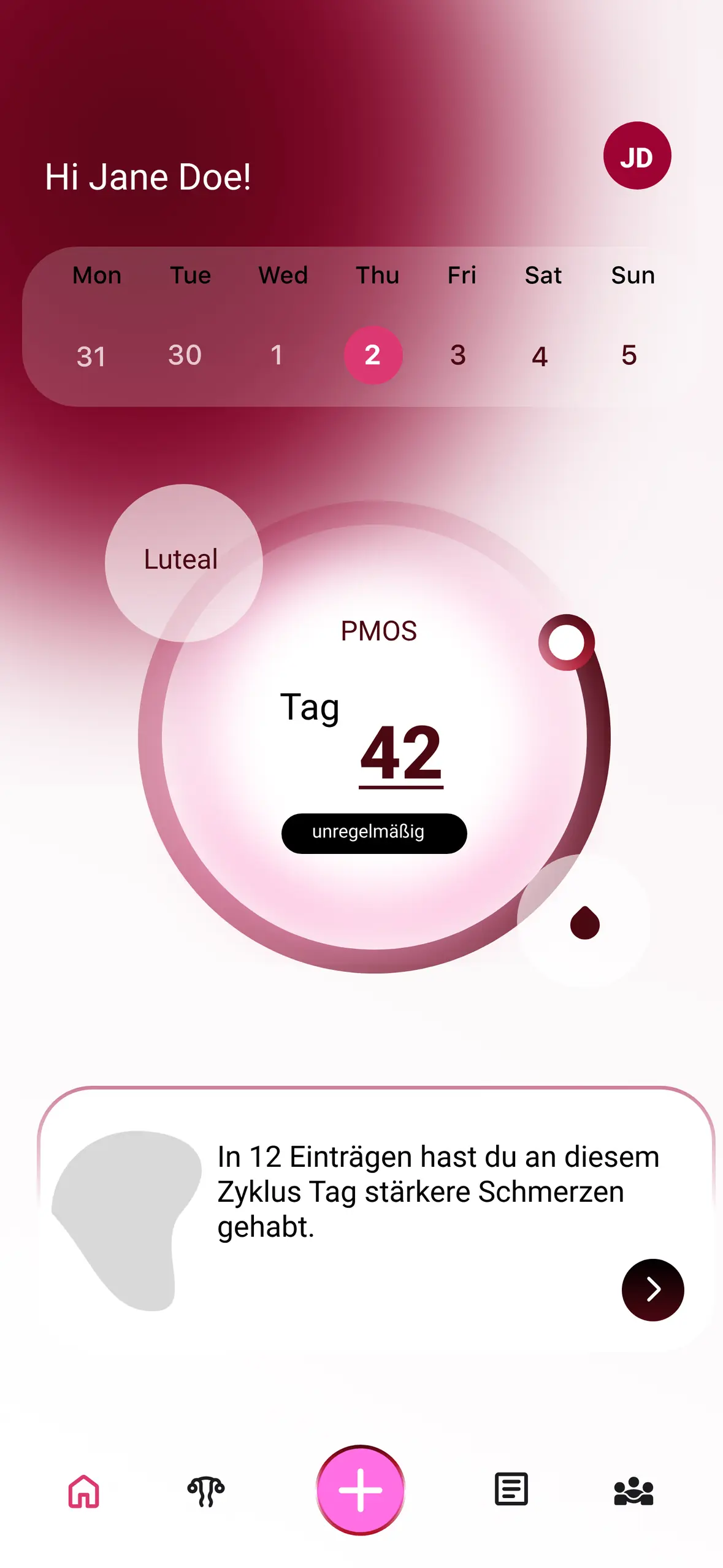
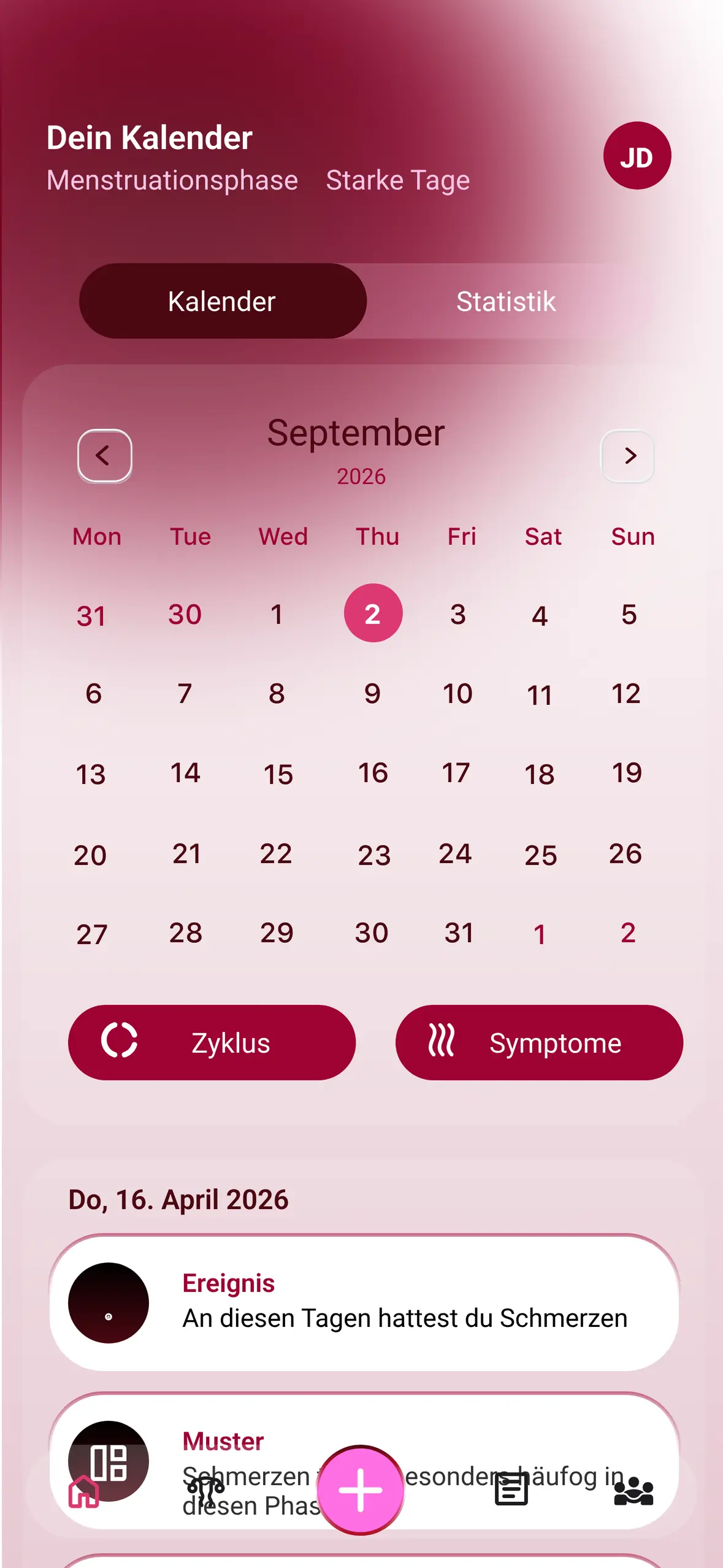
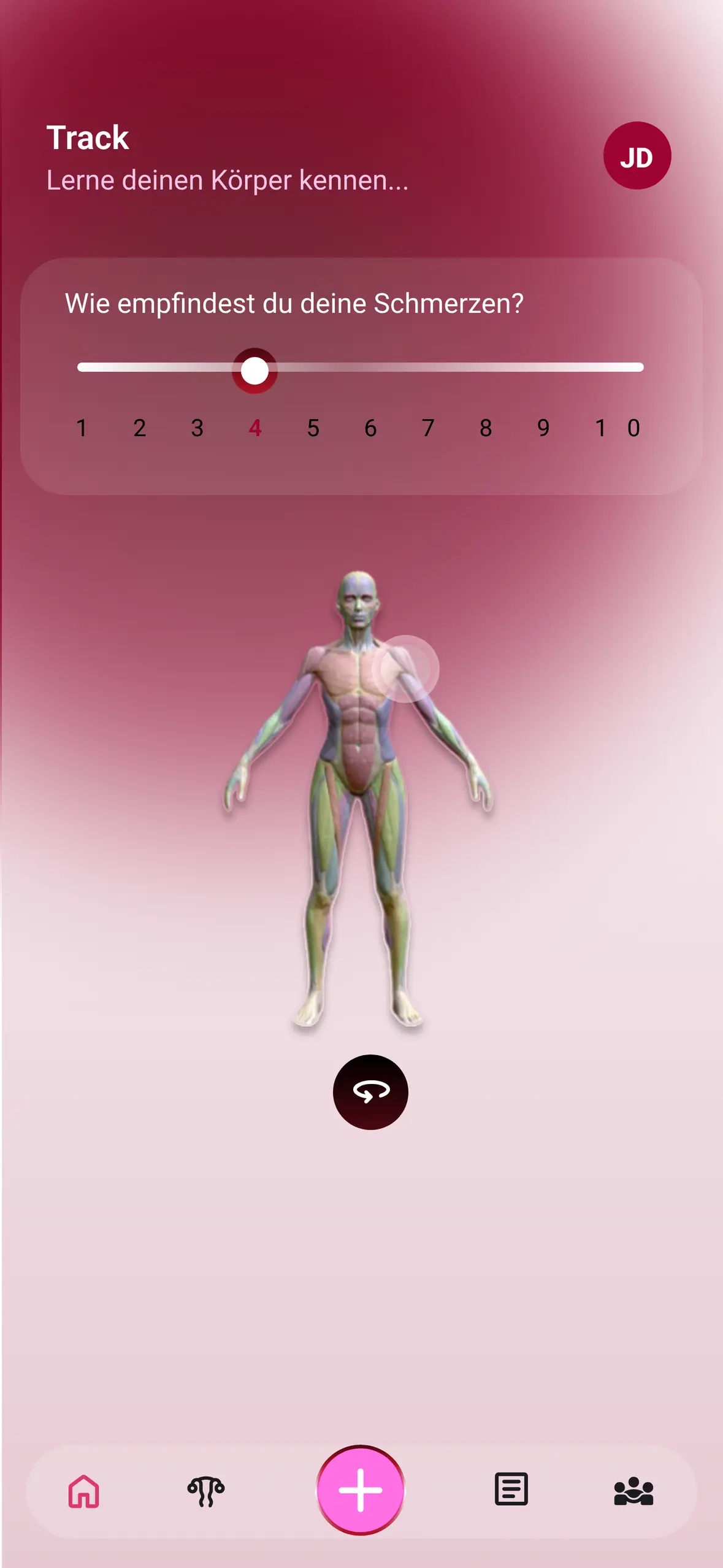

Understand your symptoms. Own your health.
UTERA provides symptom intelligence for every cycle, including the complex and irregular ones. It is built to help you recognise patterns instead of predicting your next period.
The app is still in development. Join the waitlist to help shape it and get early access to the closed beta.
Supported by



On the basis of a decision by the German Bundestag. The programme „exist – from science to business“ with its projects is funded by the Federal Ministry for Economic Affairs and Energy and the European Union through the European Social Fund Plus (ESF Plus).
Where you are now
Built for every stage of your health journey
Whether you are still looking for a name for what you feel, or you have had one for years, the app meets you where you are.
Seeking answers
Understand your symptoms and explore what is possible.
Getting clarity
Personalised insights that make sense for your body.
Managing your condition
Track, learn and take control with confidence.
Before and after
UTERA supports you before and beyond diagnosis
Before diagnosis
- Analyse symptoms over time
- Recognise recurring patterns
- Build a structured symptom history
- Prepare for doctor appointments
After diagnosis
- Monitor symptoms and changes
- Discover possible triggers
- See patterns at a glance
- Support long term symptom management
The idea
What symptom intelligence actually means
Symptom intelligence means reading your symptoms as one connected history instead of as separate days. UTERA looks across everything you have logged, finds the combinations that keep coming back, and shows you when they happen and what they line up with.
A cycle tracker tells you what day it is. UTERA connects what you logged in March to what you feel in June, and shows you the shape of it.
Three cycles of logged entries. The pattern is the point, not any single day.
The appointment
Walk in with a record, not just your memory
UTERA summarises symptoms, timelines, changes, and open questions in a structured report you can take to a medical appointment. UTERA does not diagnose. It gives your symptoms a shape a doctor can read.
Who it is for
Conditions that standard trackers were never built for
A calendar app assumes a cycle that repeats on schedule. In the conditions below it does not, so the symptoms say more than the dates do.

PMOS
Polyendocrine metabolic ovarian syndrome. Renamed from PCOS by global consensus in May 2026.
10 to 13%of women are affected, around 1 in 8. Up to 70% of cases worldwide are never diagnosed.
Sources: World Health Organization, and the renaming consensus published in The Lancet, May 2026.

Endometriosis
190 millionwomen worldwide, roughly 10%. Diagnosis often takes 4 to 12 years.
Source: World Health Organization.

Adenomyosis
5 to 70%depending on study population, age and diagnostic method. One gynaecological study population reported 20.9%. Average diagnostic delay is around 11 years.
Reported prevalence varies widely with study population, age and diagnostic method.
PMS and PMDD
70 to 90%of women report premenstrual symptoms. Around a third of them meet the criteria for PMS, and 3 to 8% for PMDD.
Source: StatPearls, National Library of Medicine.
Menopause and perimenopause
45 to 55the age range in which most women reach menopause. Perimenopause begins years earlier and can last several years.
Source: World Health Organization.
more of their lives women spend in poor health than men
The gap is not only in treatment, it is in the data. Conditions that mostly affect women have been studied less, diagnosed later, and measured against averages that were never taken from women in the first place. UTERA starts from your own record instead of an average.
Source: McKinsey Health Institute with the World Economic Forum, 2024.
How it works
Understand your pattern, not just your next period
Build your symptom profile
A short onboarding captures cycle characteristics, symptoms, treatments, and the everyday factors that actually affect you.
Record only what matters
UTERA personalises daily check-ins around your symptoms and factors, instead of a generic checklist you will abandon in a week.
Connect symptoms over time
Longitudinal tracking reveals recurring combinations and changes across cycles and everyday life. These are the things a single entry can never show.
Turn data into clear insights
Personalised dashboards turn fragmented entries into understandable trends and a symptom history you can read.
Generate a medical cycle report
A structured summary of symptoms, timelines, changes, and open questions, ready for a medical or follow-up appointment.
Why UTERA
Six things UTERA can do that a cycle tracker cannot
Symptom intelligence
Find patterns across symptoms, cycles and time.
Built for complexity
Made for cycles that do not follow a textbook, and symptoms that do not arrive on schedule.
Personalised insights
Your insights are based on your own symptom history.
Longitudinal clarity
See how your health evolves over time.
Support on both sides of a diagnosis
Useful while you are still looking for a name for what you feel, and after you have one.
Built where the research is thin
Women's health has been under-researched for decades. UTERA starts from your own record, not an average that was never measured.
You are not alone
UTERA is here for every woman who has spent too long feeling unheard, unseen or dismissed. We are building a Europe-wide community and a medical app, created by someone affected, for those affected.




Community
A safe place to be taken seriously
Connect with women who understand, and help shape what we build.
Connect
Talk to women who truly understand.
Share
Share your story in your own words.
Learn
Tips, resources and expert insights.
Shape UTERA
Give feedback and help build what you need.
Waitlist
Be one of the first to use UTERA
The closed beta supports 50 to 150 users. Join the waitlist and help shape what we build.
We send one email with a confirmation link, and only once you click it are you on the waitlist. Your name and address are kept in UTERA's Google account (Gmail and Google Sheets) for this and nothing else. No tracking, no cookies, and we never share your email address.
Blog
Behind the scenes at UTERA
From the first idea to building our app, we show how we are turning a vision for better women's health into something real.
First post
Why we started UTERA
Two of us have spent years being told our symptoms were normal. This is what we decided to build instead.
Coming up
What symptom intelligence means
Pattern recognition across cycles, and why a prediction is not the same thing as an explanation.
Coming up
Inside the closed beta
How the first 50 to 150 users will shape what the app becomes.
About us
The story behind UTERA
A team of six based in Stuttgart and living across several countries, two of whom live with the conditions this app is built for.
Built by people it is built for.
Two of us on the team live with the conditions UTERA is designed for. The product decisions come from that, not from a market study.
Six people. One question.
Business, computer science, media informatics, marketing, biology and psychology, spread across several countries, working on how complex cycles get understood.
Backed to do it properly.
EXIST funding through the Federal Ministry for Economic Affairs and Energy and the European Social Fund Plus, based in Stuttgart.